
Beauty in the Familiar
Kristen Clawson
Aug 18, 2026
When I began thinking about my piece for How We See It, I found myself looking at something I see almost every day: a eucalyptus tree.
There is something wonderful about living in the Ojai Valley. We are surrounded by an abundance of natural beauty, but because we see it so often, it can become part of the background. We drive past the same trees, walk beneath the same branches, and notice the landscape without always really seeing it.
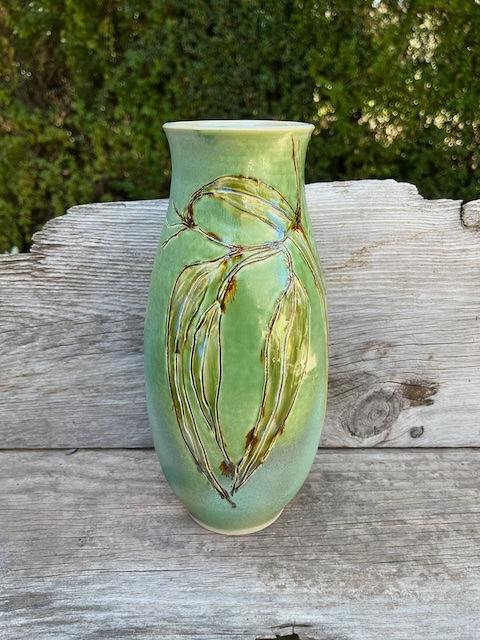
A single eucalyptus branch from a local tree became both my subject and my tool. I placed the leaves directly onto the clay and traced their forms, then carefully carved each line by hand. The process made me pay attention to details I might normally overlook—the length and curve of the leaves, the branching veins, the irregularities that make each one unique.
I then applied slip to create texture and depth before applying four different layers of glaze. Each layer contributes something different, creating depth, movement, and subtle variations across the vessel.
I titled the piece Beauty in the Familiar because I think we sometimes need to pause and really see the things we have become accustomed to. Beauty doesn't always announce itself.
This piece is my invitation to slow down and look more closely, because sometimes How We See It begins simply with taking the time to notice.
Beauty in the Familiar
Kristen Clawson
Aug 18, 2026
When I began thinking about my piece for How We See It, I found myself looking at something I see almost every day: a eucalyptus tree.
There is something wonderful about living in the Ojai Valley. We are surrounded by an abundance of natural beauty, but because we see it so often, it can become part of the background. We drive past the same trees, walk beneath the same branches, and notice the landscape without always really seeing it.
A single eucalyptus branch from a local tree became both my subject and my tool. I placed the leaves directly onto the clay and traced their forms, then carefully carved each line by hand. The process made me pay attention to details I might normally overlook—the length and curve of the leaves, the branching veins, the irregularities that make each one unique.
I then applied slip to create texture and depth before applying four different layers of glaze. Each layer contributes something different, creating depth, movement, and subtle variations across the vessel.
I titled the piece Beauty in the Familiar because I think we sometimes need to pause and really see the things we have become accustomed to. Beauty doesn't always announce itself.
This piece is my invitation to slow down and look more closely, because sometimes How We See It begins simply with taking the time to notice.
Beauty in the Familiar
Kristen Clawson
Aug 18, 2026
When I began thinking about my piece for How We See It, I found myself looking at something I see almost every day: a eucalyptus tree.
There is something wonderful about living in the Ojai Valley. We are surrounded by an abundance of natural beauty, but because we see it so often, it can become part of the background. We drive past the same trees, walk beneath the same branches, and notice the landscape without always really seeing it.
A single eucalyptus branch from a local tree became both my subject and my tool. I placed the leaves directly onto the clay and traced their forms, then carefully carved each line by hand. The process made me pay attention to details I might normally overlook—the length and curve of the leaves, the branching veins, the irregularities that make each one unique.
I then applied slip to create texture and depth before applying four different layers of glaze. Each layer contributes something different, creating depth, movement, and subtle variations across the vessel.
I titled the piece Beauty in the Familiar because I think we sometimes need to pause and really see the things we have become accustomed to. Beauty doesn't always announce itself.
This piece is my invitation to slow down and look more closely, because sometimes How We See It begins simply with taking the time to notice.