top of page

christine beirne

​

Painting

​

​

ARTIST STATEMENT

My work begins with looking. Through drawing and painting, I explore the shapes, values, rhythms and colors of a place—and what remains after that first encounter.

My ongoing Morning Practice consists of small grayscale drawings made with fineliner and Copic markers. These drawings help me slow down, simplify complex landscapes and discover their underlying structure.

The Observation series carries this process into larger, more abstracted paintings. I return to what drawing revealed—value, shape, line and memory—and allow the painting to become something new. Each work moves between recognition and abstraction, rooted in a particular place and an act of looking.

My travels and longstanding plein air practice continue to inform this work. I live and work in Ojai, California.

VIEW THIS ARTIST'S POSTS

The Art of Looking: From Drawing to Painting

When I began my daily Morning Practice drawings, I had three goals: improve my drawing skills, develop a better understanding of values (the lights and darks in a scene), and ultimately become a better plein air painter. What I didn’t anticipate was how much those little drawings would change the way I see. Working with Copic grayscale markers was a real lightbulb moment for me. Suddenly, I wasn’t distracted by color. I was learning to recognize shapes, relationships, and the patterns of light and dark that give a scene its structure. Reducing a complicated landscape to just four values forced me to make decisions about what was important — and what wasn’t. Over time, something unexpected happened. The drawings began to take on a life of their own. What started as an exercise to improve my painting became a body of work in its own right. These little drawings weren’t simply studies anymore. They could stand on their own. But today, while plein air painting at Rancho Camulos, I was reminded of why I started this practice in the first place. Before picking up my palette knives, I made a small grayscale drawing of the scene. It wasn’t nearly as detailed as my usual Morning Practice drawings. It didn’t need to be. Its purpose was to help me understand what had attracted me to the scene and how I wanted to interpret it. And I kept coming back to it. As I painted, whenever I found myself questioning a value, getting distracted by color, or losing sight of my original intention, I looked at that little drawing clipped beside my easel. It brought me back to what mattered. Now, couldn’t I have just taken a photograph and referred to that? Possibly. But there’s something important that happens when you draw. You’re not simply recording what’s in front of you. You’re making decisions. You’re solving problems. You’re interpreting. For example, I decided to lower the palm tree in my composition. In the actual scene, much of its crown was outside my picture area. By working through the composition in my drawing first, I could make that adjustment before touching the painting. And perhaps just as importantly, I’d already spent time studying the scene. The relationships, shapes, and values were familiar. When I began painting, there was already a kind of muscle memory at work. The drawing had helped me figure out not just what I was looking at, but what I wanted to say about it. Over the past several months, I’ve heard so many people say, “I need to do that!” or “I really should start drawing.” And one of the questions I hear most often is, “What do you use, Chris?” Well, now you have the chance to find out — and try it yourself! I’m offering The Art of Looking: Drawing & Values, a hands-on workshop where we’ll explore how to simplify what we see, recognize values, and turn observation into a drawing. You don’t need drawing experience (I have tools I’m going to show you to help!) And if you’re already a painter, you may discover a new way to approach your work. Best of all, all the supplies are included — and they’re yours to keep. You’ll leave with the same kinds of tools I use in my own practice, along with the experience to continue exploring on your own. Because sometimes, learning to see a little differently can change everything. The Art of Looking: Drawing & Values Workshop details and registration: christinebeirne.com Use code LOOK10 for a special discount through Sunday, November 8.

Think You Know My Work? Come Look Again.

If you’ve visited my studio before, you may remember my landscape paintings—places encountered on the road or close to home, explored through color, light and texture. This year, I have something new to share. If you’ve visited my studio before, you may remember my landscape paintings—places encountered on the road or close to home, explored through color, light and texture. You’ll still find those landscapes when you visit this year, alongside a new direction I’m excited to share. My ongoing Morning Practice drawings have been changing the way I see—and the way I paint. Working with a limited range of grays, I study shapes, lines and the relationships between light and dark. Those discoveries are now finding their way into larger, more abstract paintings. Observation 1: The Sierras is the first painting in my new Observation series. It builds on what I learned through drawing, giving me room to explore the structure of a place and what I remember of it. Landscape continues to be central to my work. Sometimes I explore it directly through plein air and studio paintings; sometimes a drawing leads me toward abstraction. During the tour, you’ll be able to see these approaches together—the landscapes, the drawings and the new Observation paintings—and discover the connections between them. Returning to an artist’s studio is a chance to see how the work is developing. If you’ve visited before, I’d love to welcome you back and show you what I’ve been exploring. And if this is your first visit, there’s plenty to discover.

The Art of Looking

Most of us stop looking much sooner than we think we do. We see a tree and our brain tells us “tree.” We see a mountain and think we know its shape. But drawing asks us to stay with what we’re seeing just a little longer. For the past couple of years, I’ve maintained a regular drawing practice I call Morning Practice. Most of the drawings begin with my own photographs, often taken while traveling or simply moving through the landscape. The materials are simple: line and a limited range of gray values. What interests me is the looking. When I draw, I try to stop thinking first about what something is and instead look at the shapes, values, angles and relationships. Where does one shape end and another begin? Where are the darkest darks and lightest lights? Again and again, I discover that what I thought I saw isn’t quite what is actually there. Over time, I began to realize that this practice wasn’t just changing my drawings. It was changing my paintings. Observation 2: Atigun Pass grew directly out of that experience. I photographed Atigun Pass while traveling through Alaska’s Brooks Range. When I later returned to the landscape through drawing, I began to see beyond mountains, road and sky. I noticed the underlying structure—the shapes, lines, divisions and relationships that held the landscape together. When I returned to Atigun Pass in paint, I wasn’t interested in reproducing the photograph. I wanted to bring what I had discovered through drawing into the painting. The landscape remained the source, but observation became more important than representation. That exploration became Observation 2: Atigun Pass and has continued to influence the direction of my work. It has also led me to develop The Art of Looking, an adult drawing workshop based on the same observational process I use in my studio. Perhaps that’s what Morning Practice has taught me most of all: observation is a skill. The more we practice it, the more we begin to see. Come see where drawing and painting meet in my work during the Ojai Studio Artists Tour, October 10–12. I’ll have paintings and Morning Practice drawings in the studio—and I’d love to share what I’ve been working on.

Featured in Urban Artist Magazine

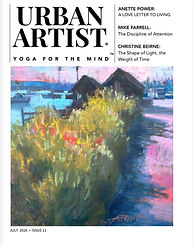
I’m excited to share that I was recently interviewed by Urban Artist Magazine. The conversation covered my artistic journey, how my Morning Practice drawings have become an important part of my daily life, and the ways those drawings continue to influence my larger paintings. We also talked about working from direct observation, painting en plein air, and how spending time truly looking at a place has become central to my practice. As artists, we don’t often stop to reflect on how our work has evolved. This interview gave me the opportunity to do just that, and I’m grateful to Urban Artist Magazine for the thoughtful conversation. If you’d like to read the interview, you can find it here: Read the interview: https://heyzine.com/flip-book/ea878857bf.html I hope you enjoy the conversation!

Making Space, Moving Home

This April, I won’t be open for Ojai Studio Artists’ Second Saturday. After months of living in between, our belongings are finally being returned following the fire just before Thanksgiving. The timing overlaps with Second Saturday, and I need to be present as everything comes back into our home—unpacked, checked, and, piece by piece, put back into place. The construction is mostly complete, and this marks a long-awaited shift: we’re moving home. I’m also looking forward to getting my studio back in order—over the past months it’s become a kind of “command central” for the construction process, with all sorts of things finding their way in that don’t normally belong there. It will be good to return it to a space for making. It feels significant in a quiet way. Not just returning to a space, but rebuilding a sense of order and familiarity after a period that has asked for a lot of flexibility and patience. I’ll be taking a break from unpacking to participate in Cross Pollination: The Intersection of Art and Nature—a plein air paint out at the Ventura Botanical Gardens on Friday, April 10 from 9–4. Admission is free that day, so if you’re in the area, come by and say hello. While I won’t be open for Second Saturday, I do plan to step out and visit some of my fellow neighborhood artists—many whose studios I rarely get to see since we’re usually all showing at the same time. Later, I may head back to the gardens as the paint out continues through the weekend. And just a few days earlier, I’m excited to be part of something new: I’m included in a group of artists from Studio Channel Islands Art Center now showing on Artsy, with an in-person exhibition opening April 4 from 4–6 pm. This show marks the launch of that program and brings the work into a physical space. If you’re not able to make it out in person this month, I invite you to visit my website. Any work purchased directly there supports something close to home—10% is donated to the Ojai Valley Land Conservancy. As a landscape painter, I’m deeply grateful for the places they’ve helped preserve. La Cañada Larga Road, in particular, is one I hold close—it’s hard to imagine it ever having been at risk of development. Supporting OVLC feels like a way of giving back to the land that continues to give so much. Thank you, as always, for your continued support—I look forward to welcoming you back soon, once things have settled. —Christine

What We Choose to Keep

On view at Integrity Wealth in Ojai through April 24, this exhibition brings together landscape drawings rooted in Ojai and selected works from my Dreamscape series. Together, they reflect two ways I move through place — direct observation and slow excavation — both shaped by the land that surrounds us. The drawings are grounded in observation. Many are based in and around Ojai — places I return to repeatedly because they continue to shift, subtly, with light, season, and memory. The Dreamscape paintings move in a different direction. They are less about a specific site and more about the felt experience of terrain — erosion, atmosphere, distance, and time. Supporting the Land That Shapes the Work Integrity Wealth does not take a commission on artwork sales. Because of that generosity, a portion of each sale from this exhibition — 20% — will be contributed to the Ojai Valley Land Conservancy. I’ve chosen to extend that same commitment to my studio practice as a whole: 20% of all original artwork sold directly through my website also supports the Conservancy. As a plein air and landscape artist — and simply as someone who loves being outdoors — I’m deeply aware that the places I paint are not guaranteed. They exist because people protect them. One place especially close to me is La Cañada Larga Road. There was a time when development felt imminent there. I remember hearing that and feeling physically unsettled — the thought that this open stretch of land, this quiet geometry of road cutting through hills, might disappear. That I might not be able to stand there again and look out across that space. The Ojai Valley Land Conservancy raised the funds to purchase and preserve it. Now, as with so many protected landscapes, the need is ongoing — stewardship, maintenance, care. Preservation isn’t a single act. It’s a long-term promise. If my work is rooted in landscape, it feels only right that the work also gives back to it. Additional Exhibitions I’ll also have work included in the Member Show at Studio Channel Islands Art Center, on view March 7 – March 20, with an opening reception at 4:00 pm on Saturday, March 7 at the Blackboard Gallery in Camarillo. And I’m part of a curated group of present and past Artists in Residence at SCIART, now featured on the Artsy platform. The collection highlights regional artists exploring a range of mediums and approaches, expanding visibility beyond our immediate area. Closing Thoughts When I think about this season of work — drawings made from walking the edges of Ojai, paintings built slowly in the studio, conversations happening in galleries and offices — it all comes back to one thing: attention. Attention to place. Attention to memory. Attention to what could be lost — and what can still be protected. La Cañada Larga Road is more than a subject to me. It’s a reminder that landscapes are not permanent unless we choose to care for them. The fact that it remains open — that I can return again and again to draw it — is not accidental. It’s because people acted. The work currently hangs in a space devoted to planning for the future. In a small way, this is my version of that — reinvesting in the land that shapes the work. If you’ve ever felt relief stepping into open land… If you’ve ever had a place you hoped would still be there tomorrow… Then you understand why this matters to me. I hope you’ll stop by before April 24.

Subscribe for OSA news

Thanks for subscribing!

Ojai Studio Artists, 1129 Maricopa Hwy 243-B, Ojai  Calif  93023

© All Rights Reserved
bottom of page